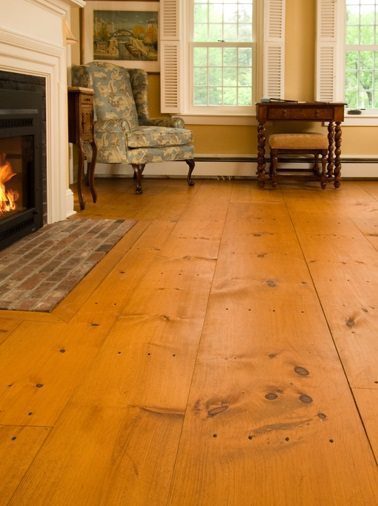
You absolutely love the pumpkin-colored appearance of Old Growth Eastern White Pine flooring. You’re sold on the antique look of the wide planks. You are happily anticipating the mellowing patina of the Pine’s color as the years go by. But you have concerns about the “softer side” of installing a Pine floor:
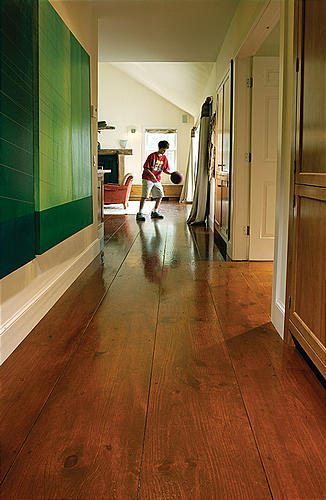
Will it hold up to the daily rigors of your toddler and 6-year-old’s playtime?
What will happen to your Pine floor after several months of living under your 80-pound golden retriever?
How will it look after many years of muddy shoes, dropped forks and knives, furniture moving, and general everyday use?
Old Growth Eastern White Pine isn’t the hardest wood used in Carlisle flooring, but it is certainly the most original and authentic wood used to craft traditional wide plank floors.
It is the wood that is most cherished among homeowners seeking an antique look. If you are looking for a perfectly flawless floor year in and year out, you might want to go with a harder wood. But Old Growth Eastern White Pine flooring is for you if you value the traditions of the past, including your family’s own history told in the endearing “dings and dents” this Pine floor acquires over the years.
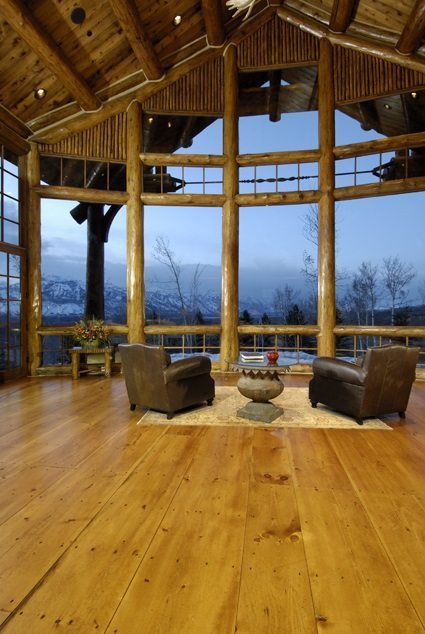
On the other hand, our Old Growth Eastern White Pine is harder than you might think. Each of our floors is made from Old Growth timber that is 100 or more years old and has been sawn from the center of the tree (the most dense part). It is then slowly air- and kiln-dried, which makes it extremely rugged and durable. Because Old Growth Eastern White Pine is such a resilient wood, it stands up to the expansion and contraction that comes with the changing seasons. This ability to adapt to change is one of the things that makes our Pine a durable, long-lasting floor. While you can sand the floor again after several years to remove signs of wear, we’ve found our clients just touch up the floor with Tung Oil after about five years.
Posted on Jan 21, 2010 AT 10:03 AM in (3) Comments
I am currently dealing with Shannon at Carlisle floors, my only concern with the eastern white pine is the wider boards cuping. I live in South Alabama and the humidity that comes with our climate can make any wood extremly volitale. Shannon has assured me that this will not be a problem, but with such an expense how can I be sure? What are your thoughts about the wider board? The softness of the wood is not a concern. Thanks Lee
POSTED AT 04:13 AM ON Oct 12, 2011
Hi Lee, This is Shanon, I saw your blog post this morning and wanted to reply - thanks for taking advantage of our blog to connect with our customers. I would love to have you talk to one of our customers, if you have not heard from any already. We actually worked with a great couple in Montgomery, AL and he has our 13-20” wide pine in his house, its been installed since 2006. I will send Ashley a private email with this persons contact information. He would actually love to show you his floors if you want to drive to Montgomery, or give him a call. He is in the gardening/flower business so things are pretty busy until after Mother’s Day, but if you give him a call he’d love to talk to you by phone!
POSTED AT 04:16 AM ON Oct 12, 2011
I read your post this morning and thought you are probably looking for some customer feedback on this, but as one of the owners at Carlisle I thought my input might be helpful from a different perspective. Shanon can certainly provide you with a list of customers in Alabama with the exact floor that you have so you can speak directly with them. From my standpoint your concern is the most frequently voiced concern that we hear on a daily basis and I am sure Shanon has covered all of the detail of our process that helps insure stability, but I am more a student of history than a process “engineer” so I actually gain the greatest confidence in considering the origin of these floors.
Over 200 years ago these floors were created out of practical construction methods as well as simple wood knowledge. Without plywood, the original settlers of the Northeastern seabord knew they wanted very large boards to truly tie the timberframe of their home together in a sturdy fashion. The longer and wider the boards they used the faster the job got done, the less sawing they had to do and the less nailing they had to do. In addition with fewer seams they created greater overall strength in the frame. However, they also installed all of this wood “green” as obviously kilns were not available. They wanted to minimize the shrinkage of the boards as well as the potential to have the boards cup and crown which would pull the nails and sacrifice the rigidity of the structure. Without kilns, glues, stress reliefs, tongue and grooves, pnuematic staplers and a host of other enhancements they had to rely on pure wood knowledge. This intimate knowledge of wood told them that if they cut a board from the center of the first log in a slow growing timber they would create the most stable plank available. This dense vertical grain would serve to eliminate a majority of the movement….and guess what? It worked! Depsite the dirt floor basements that often had wells in them, despite uneven log joists and the lack of a subfloor, despite the lack of climate control provided by central HVAC systems, despite the dramatic shifts in the interior climate of these homes, all of the floors still remain flat today.
Today we have added all the accoutrements that modern markets require, in the way of very extended drying, stress reliefs, installation guidelines and more, which when combined with the controlled environment of your home will make a far better combination for success than our forefathers encountered. However, at the end of the day, these “extras” are simply that…what will keep these boards flat is the same thing that kept them flat over 200 years ago…..extremely high quality timbers.
Thank you for taking the time to consider our floors. I truly appreciate the opportunity and I hope that maybe a slightly different perspective helps to continue to build your confidence in the fantastic floors that we craft each day.
POSTED AT 04:20 AM ON Oct 12, 2011
Customer Stories. Green building. Design tips. DIY. Our blog features lots of articles that help peel back the layers of complexity regarding your flooring choices. Subscribe to our blog.
Subscribe via RSS